Home
  • Home
  • Resource centre
  • Learning
  • About us
  • Log in
  • English
    • Français
    • Arabic
Home
  1. Resource Centre

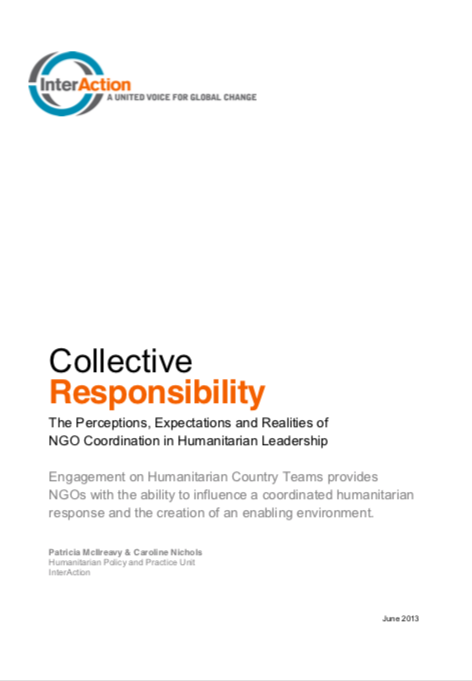
Collective Responsibility: The Perceptions, Expectations and Realities of NGO Coordination in Humanitarian Leadership

  • Studies, reviews and research
  • 2013

NGOs are widely recognized as key actors in an effective, efficient and accountable emergency response because they are frontline implementers for the majority of humanitarian operations. As such, the appropriate engagement of NGOs within humanitarian leadership is a critical component for success. Despite numerous evaluations of the cluster approach noting the value of NGO engagement, there is lack of qualitative data on the NGO role within humanitarian leadership structures. This research attempts to fill that gap. Through this study, InterAction examined the perceived and expected value of NGO engagement on and contributions to Humanitarian Country Teams (HCTs). Additionally, the research explored how NGOs leverage and lend their experience to the HCTs to improve the efficiency of humanitarian action. InterAction plans a second phase of research to examine other aspects of the architecture, notably clusters. The report also includes findings on challenges faced by all HCT members –for example, the extent to which a staff member of an independent operational organization can represent his/her peers. The recommendations within this report aim to strengthen a common understanding of the role that NGOs can fulfill on HCTs, as well as to reiterate expectations of the HCTs themselves.

Share

Share

Download
Collective Responsibility: The Perceptions, Expectations and Realities of NGO Coordination in Humanitarian Leadership

Organisation

  • InterAction

Author(s)

  • Patricia Mcllreavy
  • Caroline Nichols

Document type

  • Studies, reviews and research

Publication year

  • 2013

Thematic work area

  • Humanitarian coordination

Keywords

  • Humanitarian Country Team (HCT)
  • NGO coordination

Related documents

Note on IASC Coordination Structures at Country Level

Note on IASC Coordination Structures at Country Level

Inter-Agency Standing Committee (IASC) , NGO coordination

This note summaries IASC coordination structures and capacities in 26 operations (28 locations, taking into account the three components of the Syria response). Data was collected from the field through a rapid survey in late 20192 and is the only standardised method for capturing coordination...

  • Reports
  • 2020
Briefing Paper: Humanitarian Coordination - NGO Fora and Consortia – from Local to Global

Briefing Paper: Humanitarian Coordination - NGO Fora and Consortia – from Local to Global

Humanitarian coordination

This briefing paper summarizes discussions from the third session of the humanitarian coordination learning stream, which emphasised the importance of understanding how the NGO fora and consortia function and how NGOs can engage in these structures. The session provided examples of good practice of...

  • Briefs, factsheets and brochures
  • 2017
Pooled Funding at a Crossroads – A Comprehensive Review and Analysis

Pooled Funding at a Crossroads – A Comprehensive Review and Analysis

Financing/funding

Pooled funding has become increasingly popular as an efficient solution to enhance effectiveness of humanitarian action. The Covid-19 Global Humanitarian Response Plan organized through IASC is an example of pooled funding being used to channel funds faster to frontline humanitarian responders....

  • Studies, reviews and research
  • 2023
View more

Footer

  • Home
  • Resource center
  • About us
  • FAQ
  • Contact

ICVA - Contact information

International Council of Voluntary Agencies
Humanitarian Hub, 16 La Voie-Creuse
1202 Geneva
Switzerland

https://www.icvanetwork.org/
Subscribe to our newsletter
© 2025 ICVA | Credits