تجاوز إلى المحتوى الرئيسي
الرئيسية
  • الرئيسية
  • Resource centre
  • Learning
  • About us
  • تسجيل الدخول
  • Arabic
    • English
    • Français
الرئيسية

Note on IASC Coordination Structures at Country Level

  • Reports
  • 2020

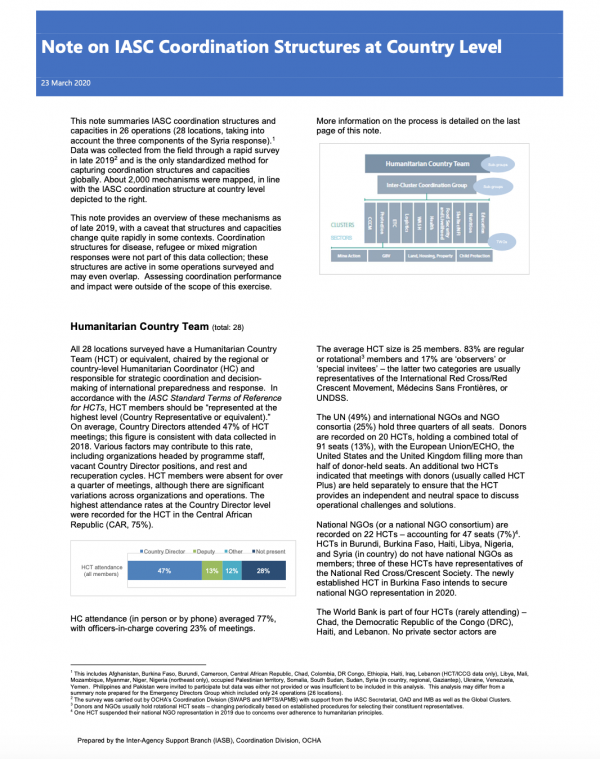
This note summaries IASC coordination structures and
capacities in 26 operations (28 locations, taking into account the three components of the Syria response). Data was collected from the field through a rapid survey in late 20192 and is the only standardised method for capturing coordination structures and capacities globally. About 2,000 mechanisms were mapped, in line with the IASC coordination structure at country level depicted to the right.
This note provides an overview of these mechanisms as of late 2019, with a caveat that structures and capacities change quite rapidly in some contexts. Coordination structures for disease, refugee or mixed migration responses were not part of this data collection; these structures are active in some operations surveyed and may even overlap. Assessing coordination performance and impact were outside of the scope of this exercise.

Share

Share

Download
Note on IASC Coordination Structures at Country Level

Organisation

  • Inter-Agency Standing Committee (IASC)

Author(s)

  • IASC

Document type

  • Reports

Publication year

  • 2020

Thematic work area

  • Inter-Agency Standing Committee (IASC)
  • NGO coordination

Keywords

  • Inter-Agency Standing Committee (IASC)
  • NGO coordination

Related documents

Collective Responsibility: The Perceptions, Expectations and Realities of NGO Coordination in Humanitarian Leadership

Collective Responsibility: The Perceptions, Expectations and Realities of NGO Coordination in Humanitarian Leadership

Humanitarian coordination

NGOs are widely recognized as key actors in an effective, efficient and accountable emergency response because they are frontline implementers for the majority of humanitarian operations. As such, the appropriate engagement of NGOs within humanitarian leadership is a critical component for success....

  • Studies, reviews and research
  • 2013
A Basic NGO Coordination Guide

A Basic NGO Coordination Guide

Humanitarian coordination , NGO coordination

This Guide is not meant to be a definitive “how to” manual, but it focuses on issues and areas to consider when undertaking NGO coordination and when setting up an NGO coordination body. It is an entry point into the world of NGO coordination – an area of humanitarian response that is vast in...

  • Manual, toolkits and guidance
  • 2013
Measuring Humanitarian Localisation in Yemen – Baseline Report

Measuring Humanitarian Localisation in Yemen – Baseline Report

Localisation

This report considers progress on localization in Yemen, measuring it across seven pillars: Partnerships, Funding, Capacity Strengthening, Coordination and Complementarity, Policy Influence, Leadership, and Participation.

  • Reports
  • 2023
  • Middle East and North Africa
View more

Footer

  • Home
  • Resource center
  • About us
  • FAQ
  • Contact

ICVA - Contact information

International Council of Voluntary Agencies
Humanitarian Hub, 16 La Voie-Creuse
1202 Geneva
سويسرا

https://www.icvanetwork.org/
Subscribe to our newsletter
© 2026 ICVA | Credits
